
Pony.ai CEO James Peng Joins MOVE London 2026 Fireside Chat on the Future of Autonomous Mobility
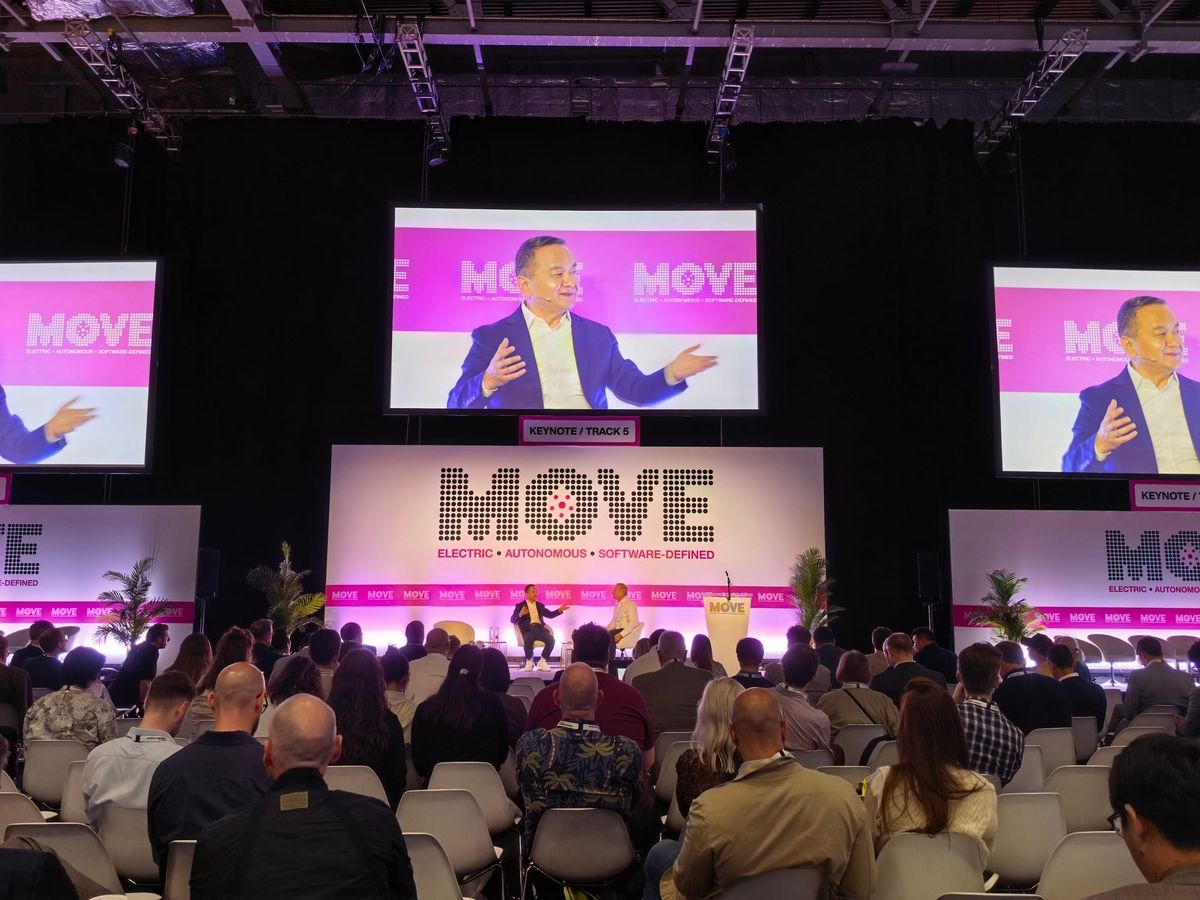
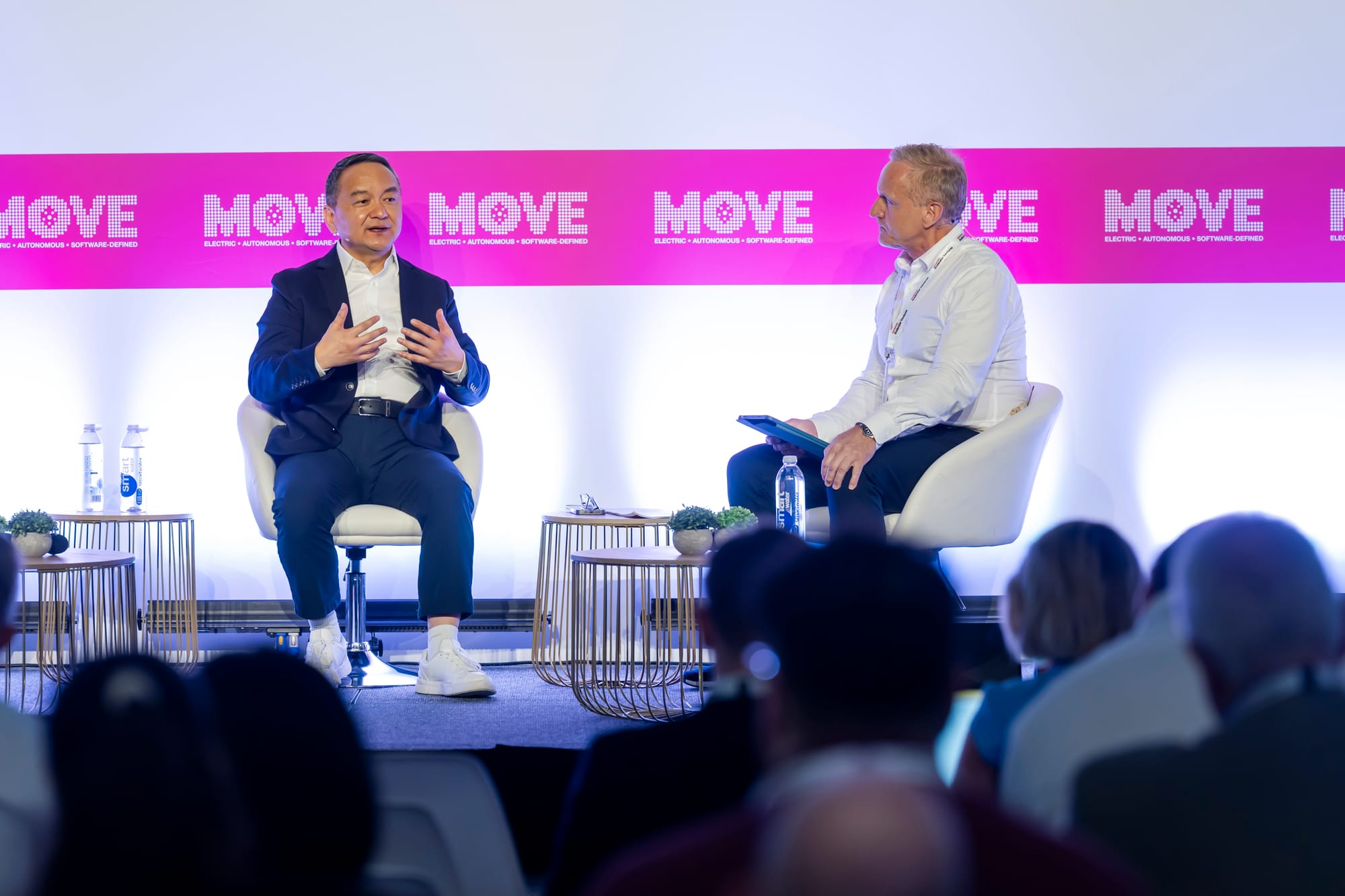
On June 17, Pony.ai Founder and CEO James Peng joined MOVE London 2026 for a fireside chat titled “Scaling Autonomy: Becoming a Global Player.” The session took place on the Keynote Stage at ExCeL London and was moderated by Michael Dean, Global Head of Automotive Research at Bloomberg Intelligence.
The conversation came as autonomous mobility continues to move from technology validation toward real-world commercial deployment. During the session, James discussed Pony.ai’s progress in scaling fully driverless Robotaxi services in China, expanding into international markets, and building a global partner ecosystem to support safe and commercially viable autonomous mobility.
James highlighted that Pony.ai now has a Robotaxi fleet approaching 2,000 vehicles, with fully driverless commercial services in Beijing, Guangzhou, Shenzhen and Shanghai. He also pointed to Pony.ai’s growing international footprint across Singapore, Dubai, Doha, Seoul, Luxembourg and Zagreb, where the company has been advancing trials and commercial operations with local partners.
A central theme of the discussion was that scaling autonomy requires more than technology alone. James emphasized the importance of safety, cost efficiency, regulatory readiness, production capability and partnerships. He also described Pony.ai’s role in the mobility ecosystem as providing the “Virtual Driver,” working with automakers, ride-hailing platforms, local operators and infrastructure partners to bring autonomous mobility to more markets.
Fireside Chat Highlights
Michael Dean:
Can you set the scene for us? Where is Pony.ai in terms of Robotaxis on the road, cities that you’re actually operational in, and how has that changed over the past 12 months?
James Peng:
Last year, we launched our Generation-7 autonomous driving vehicles, collaborating with Beijing Auto, Guangzhou Auto and Toyota.
We have already launched fully driverless commercial usage in four Tier-1 cities in China: Beijing, Guangzhou, Shenzhen and Shanghai. Those are fully driverless, with paid customers, and we have 24/7 services in some cities. The current fleet size is approaching 2,000.
We also launched testing, public rides or commercial usage in global markets such as Singapore, the Middle East, South Korea, and of course, in Europe as well.
In Zagreb, Croatia, the service is running through the downtown area, as well as from the airport. So we have definitely seen that Robotaxi is there, and it is enjoyed by many customers.
Michael Dean:
How do you scale that 2,000 up to your medium- to long-term objective of 50,000? What are the bottlenecks stopping you from getting there?
James Peng:
Robotaxi is such a complex system. Technology is just one thing. Over the last 10 years, we really got the technology right. We have accumulated more than 85 million kilometers of autonomous driving running on the roads, with strong safety track records.
On the cost side, we have really optimized. The total cost of our 2027 Robotaxi in the China market is expected to fall below USD 33,000. So cost-wise, we get it.
I think we are waiting for one thing to get ready: regulation. Once regulation is there, I think the scalability path will be exponential.
Michael Dean:
Can you talk a bit more about your expansion into Europe? What are your plans for Europe, and how quickly can you scale up?
James Peng:
The European market, first and foremost, is a very interesting market. It is a market with 500 million people and is economically very strong.
But I think the deciding factors — at least there are two factors. One is regulation. Compared with last year, this year I definitely see there are more discussions. Many more cities have a waiting list to have autonomous driving trials. But regulation still remains an uncertainty.
The second is partnership. We are definitely not going to come to Europe alone. We will work closely with our partners.
There could be many more cities coming, but the key factors are definitely those two.
Michael Dean:
What is your preferred sort of partnership? Is it with automakers themselves? Is it with ride platforms?
James Peng:
We have them both. We all play different roles.
At a high level, in the taxi business, there are four parts. One is user acquisition. Second is the vehicle. Third is the driver. Fourth is all the back-end services: cleaning, charging, servicing and maintenance.
We are providing the Virtual Driver. For all the other three categories, we will have partners. So I think it is going to be an ecosystem, not a single partner.
Michael Dean:
When I meet you hopefully in 12 months’ time, what would be the big change in your mind over this 12-month period?
James Peng:
I think the biggest change is that the whole ecosystem starts coming into place: technology, regulation, user acceptance and operational know-how.
Because autonomous mobility is such a complex system, it is really a flywheel. All the pieces need to fit together.
Another analogy is rolling a snowball. Once one piece is ready, it gets bigger and bigger. So in the next 12 months or 24 months, I think the scale will be exponential. It definitely will not be ending yet, but it will be hyper-growth.