
Pony.ai Reports Record Growth in Paid Robotaxi Services; Joint Deployment Model to Accelerate Dual-Engine Expansion

Robotaxi accounts for one-third of total revenue for the first time, with fare-charging revenue up 849.3% year-over-year
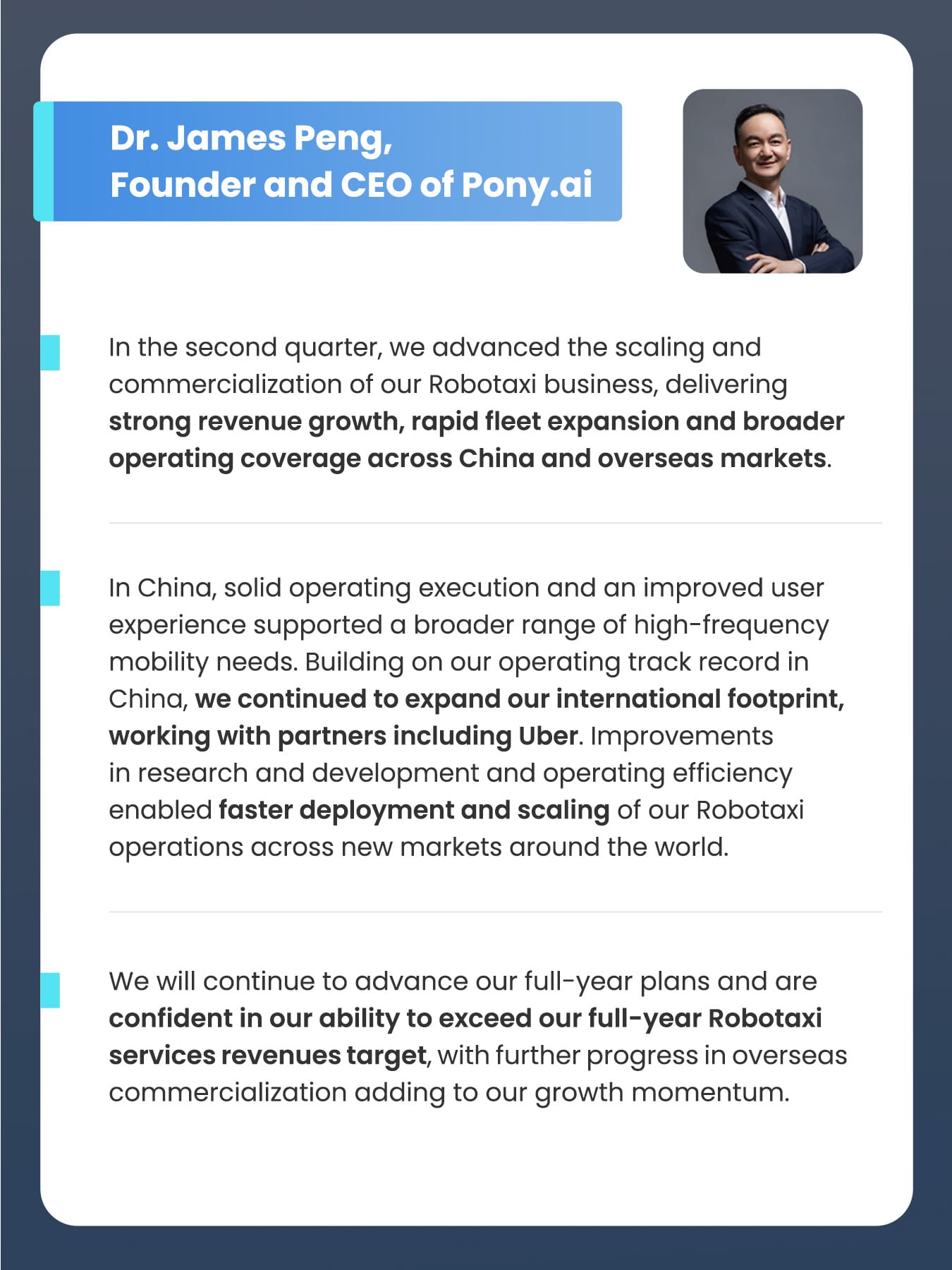
Cost reductions, operational efficiency gains and improvements in rider experience delivered by Pony.ai’s seventh-generation (Gen-7) Robotaxis are supporting growth both in China and overseas. This momentum puts the company on track to meet its full-year target of growing Robotaxi revenue to more than 3.5 times its 2025 level.
According to its latest quarterly results, Pony.ai posted its strongest growth since it began separately reporting Robotaxi paid-service revenue. Fare-charging revenue surged 849.3% year-over-year in the second quarter, while total Robotaxi revenue increased 691.2% to US$12.1 million.
Supported by the growth of its Robotaxi business, Pony.ai’s total revenue rose 68.8% year-over-year to US$36.2 million in the second quarter. Robotaxi accounted for one-third of total revenue for the first time, becoming an increasingly important contributor to the company’s growth.
Pony.ai’s operating track record in China is also supporting its overseas expansion. Recent partnership agreements, including one with global mobility platform Uber, have expanded the company’s planned and potential overseas deployments to more than 4,000 Robotaxis, giving its joint deployment model greater commercial scale.
Scaling a Proven Model in China
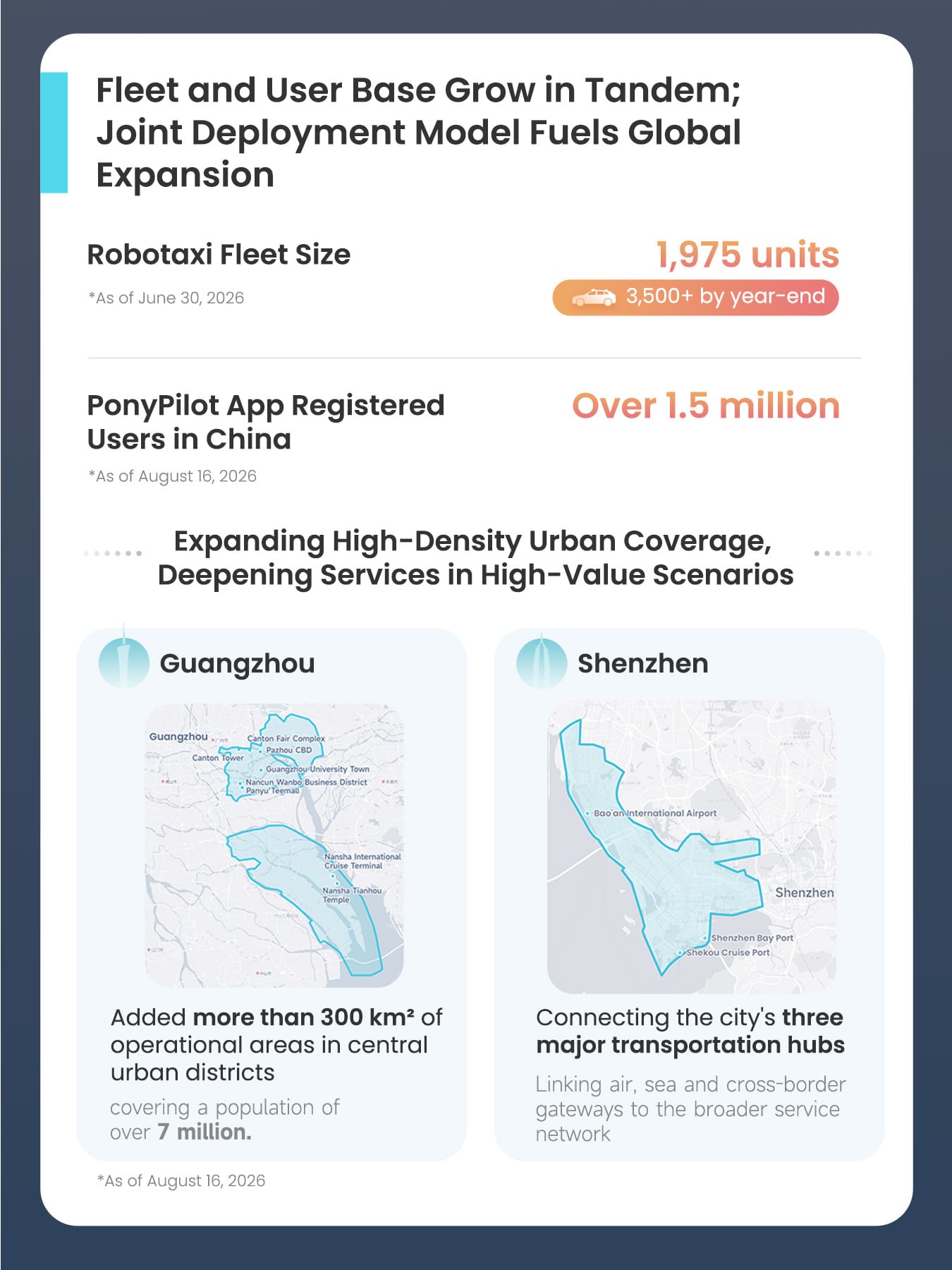
Growth in Pony.ai’s home market was broad-based, supported by solid operational execution and an improved rider experience across a growing range of everyday mobility needs. The company’s number of registered users in China reached 1.5 million.
In Guangzhou, where Pony.ai has achieved unit economics breakeven, operations expanded beyond Nansha District into central urban areas including Haizhu, Tianhe, Huangpu and Panyu. The expansion has added around 300 square kilometers of operational coverage since the beginning of the year, serving more than 7 million people across areas that include major tourist attractions, business districts and clusters of corporate headquarters.
In neighboring Shenzhen, where Pony.ai has also reached unit economics breakeven, its Robotaxis now serve several of the city’s most important transportation gateways, connecting the network with high-volume air, sea and cross-border travel. These include Shenzhen Bao’an International Airport, Shekou Cruise Homeport—a major cruise and ferry terminal—and Shenzhen Bay Port, a major land crossing with Hong Kong where daily passenger traffic reached a record 215,000 earlier this year.
Following the commercial rollout of two Gen-7 Robotaxi models, a third model developed and manufactured in partnership with Toyota also entered service in China’s tier-one cities. The additional model is supporting greater deployment density and a more consistent ride-hailing experience. Pony.ai’s total Robotaxi fleet reached 1,975 vehicles as of June 30, 2026.
Building Global Scale Through Joint Deployment
As scaled Gen-7 deployment begins translating into stronger commercial results in China, Pony.ai’s overseas business is also gaining momentum. The operating track record built in its home market—spanning fully driverless service, sustained rider demand and positive unit economics—is providing partners with a tested foundation for deployment in new markets.
The company recently secured multiple partnerships under the joint deployment model, bringing its total overseas deployment pipeline to over 4,000 vehicles. Among the partnerships, Pony.ai and Uber plan to deploy more than 2,000 Pony.ai Robotaxis in Europe.
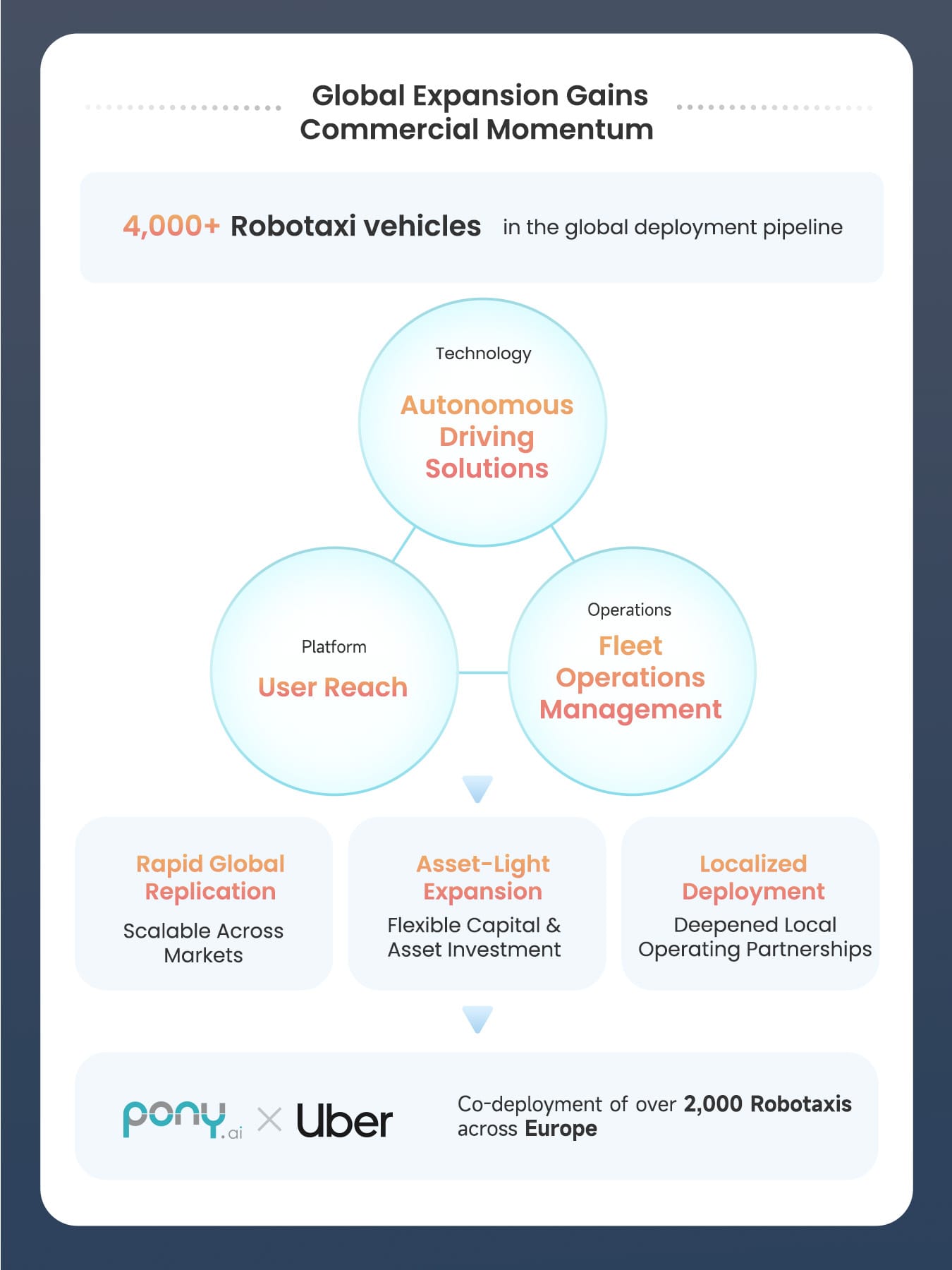
Pony.ai’s joint deployment model brings together the three core capabilities required to scale Robotaxi services: autonomous driving technology, access to rider demand and day-to-day fleet operations. Pony.ai provides its L4 technology and commercialization experience; mobility platforms connect services with users and support functions such as booking, payment and customer service; and local operating partners manage vehicle deployment and fleet operations. The mix of partners can vary by market, allowing the model to adapt to local requirements while supporting a more capital-efficient path to scale.
Pony.ai also made progress in Singapore and Luxembourg during the second quarter. In Singapore, Pony.ai and ComfortDelGro made their autonomous mobility service in Punggol available for booking through ComfortDelGro’s Zig app, expanding access beyond the earlier by-invite phase. In Luxembourg, Pony.ai, Bolt and Stellantis launched an autonomous mobility pilot to validate safety, performance and regulatory readiness in local traffic conditions, with the partners working toward fully driverless readiness by the end of the program.
Dr. Tiancheng Lou, Founder and CTO of Pony.ai, commented, “Our strategic early investments in full-stack L4 autonomous technology and advanced world models are now translating into greater efficiency across research and development, testing and fleet operations. PonyWorld 2.0 enables us to deploy Robotaxi fleets across multiple countries and cities simultaneously without a proportionate increase in engineering resources. ”
Robotruck Revenue Rises as Gen-4 Deliveries Begin
Pony.ai’s Robotruck business also delivered strong results in the second quarter, with revenue increasing 40% year-over-year. The company has begun mass production of its fourth-generation (Gen-4) Robotrucks on schedule and has initiated commercial deliveries. Pony.ai partnered with China Merchants Port in Shenzhen to begin commercial deployment of Gen-4 driverless Robotrucks in real-world, mixed-fleet logistics operations.
During the second quarter, the company’s Intelligent Solutions business recorded revenue of US$10.8 million, broadly flat from the same period last year.
Net loss in the second quarter narrowed 14.9% year-over-year to US$45.4 million, primarily due to certain non-operating items.
“Our progress across China and international markets shows that autonomous driving at scale is not only technologically viable, but increasingly commercially sustainable, with a clearer path to profitability,” said Dr. Leo Wang, Co-founder and CFO of Pony.ai. “We have the momentum and financial resources to execute against our full-year priorities while continuing to invest for sustained, multi-year growth.”
About Pony AI Inc.
Pony AI Inc. is a global leader in achieving large-scale commercialization of autonomous mobility. Leveraging its vehicle-agnostic Virtual Driver technology, a full-stack autonomous driving technology that seamlessly integrates Pony.ai's proprietary software, hardware and services, Pony.ai is developing a commercially viable and sustainable business model that enables the mass production and deployment of vehicles across transportation use cases. Founded in 2016, Pony.ai has expanded its presence across China, Europe, Asia, the Middle East and other regions, ensuring widespread access to its advanced technology.
For media inquiries, please contact:
Pony.ai: media@pony.ai
Safe Harbor Statement
This press release contains statements that may constitute “forward-looking” statements pursuant to the “safe harbor” provisions of the U.S. Private Securities Litigation Reform Act of 1995. These forward-looking statements can be identified by terminology such as “will,” “expects,” “anticipates,” “aims,” “future,” “intends,” “plans,” “believes,” “estimates,” “likely to,” and similar statements. Statements that are not historical facts, including statements about Pony.ai’s beliefs, plans, and expectations are forward-looking statements. Forward-looking statements involve inherent risks and uncertainties. Further information regarding these and other risks is included in Pony.ai’s filings with the SEC and the Hong Kong Stock Exchange. All information provided in this press release is as of the date of this press release, and Pony.ai does not undertake any obligation to update any forward-looking statement, except as required under applicable law.