
Pony.ai Reports Faster Revenue Growth as Robotaxi Expands Its Reach and Deepens Commercial Operations
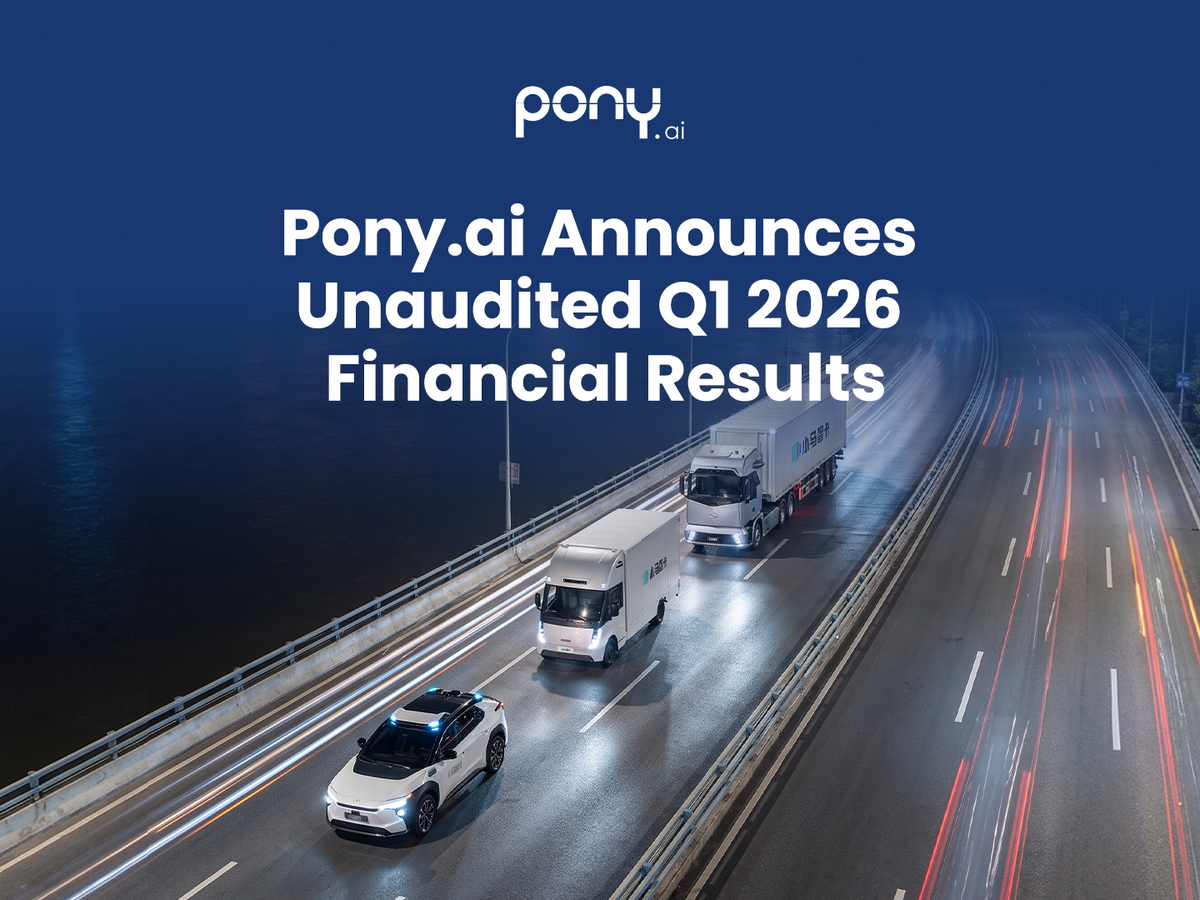
Pony.ai said Wednesday that its revenue growth accelerated in the third quarter as its Robotaxi business expanded into new markets and deepened operations in existing ones, both in China and overseas.
Total revenues rose 75.2% from a year earlier, up from 68.8% growth in the second quarter. Robotaxi services revenue increased 165.4% year over year to US$17.8 million. Broader commercial use of the Gen-7 fleet drove growth in fare-charging revenue, while increased vehicle deployments under the joint deployment model in China and overseas also contributed to Robotaxi revenue growth.
Fare-charging revenue grew nearly 400% year over year. The Robotaxi business accounted for a record high of nearly 40% of total revenues, up from 26.3% in the same quarter last year and continuing an upward trend. Pony.ai’s global Robotaxi fleet reached 2,768 vehicles at the end of September, putting the company on track to meet its year-end target of 3,500 vehicles.
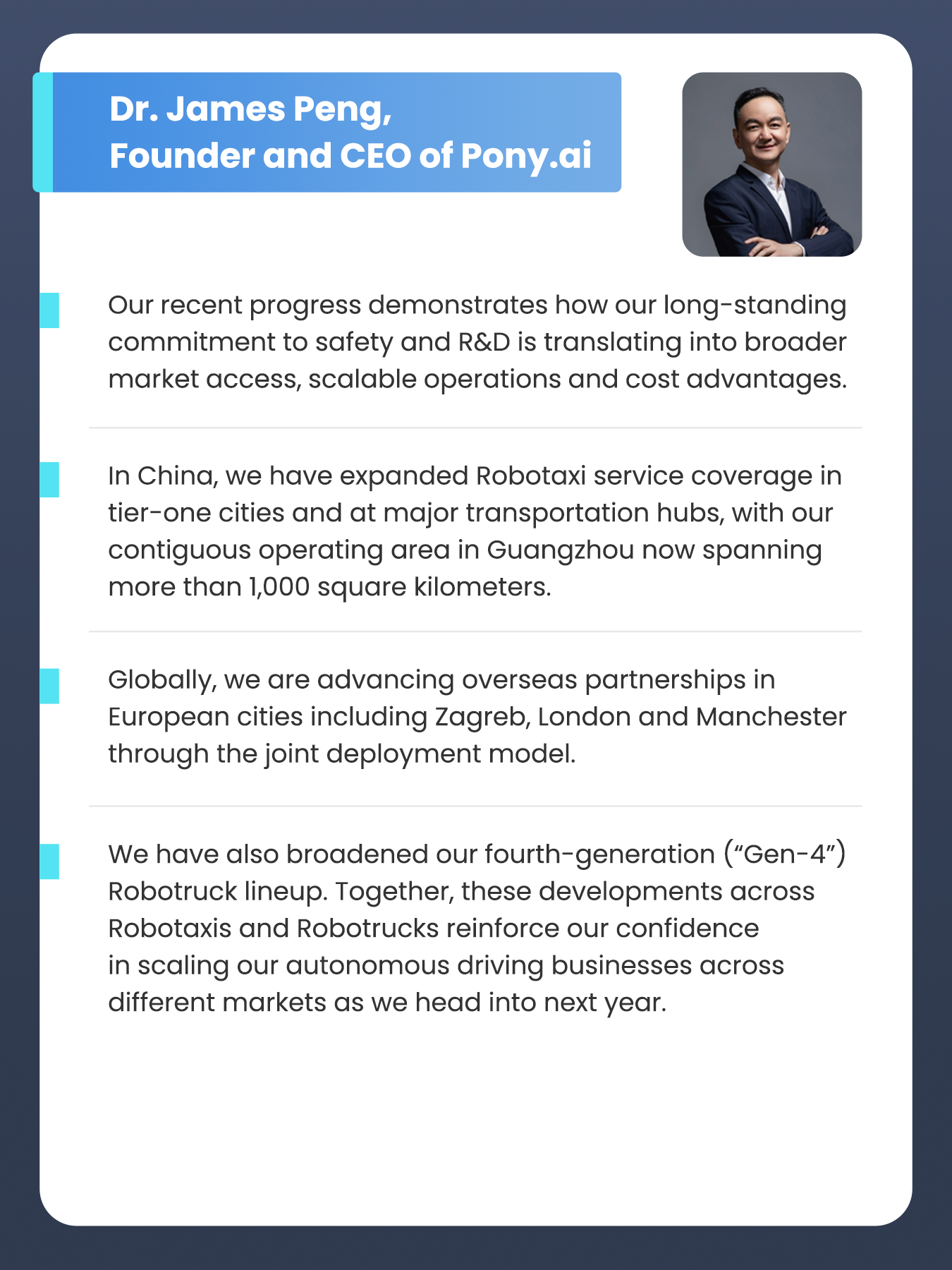
Pony.ai is scaling its Robotaxi business on two fronts. It is widening its reach by adding vehicles, expanding coverage and deploying in new cities. It is also deepening operations in markets it already serves, connecting service areas so riders can book longer trips and moving from rides with onboard safety operators to fully driverless commercial service or passenger trials, depending on the market.
In China, all three of Pony.ai’s Gen-7 Robotaxi models, jointly developed with BAIC, GAC and Toyota, are now in fully driverless commercial operation. As the fleet builds a longer safety record, the company is seeing lower operating expenses such as insurance costs. Following renewal, insurance premiums per Gen-7 Robotaxi were down 19% from a year earlier.
In Guangzhou, Pony.ai extended coverage farther into the urban core under the citywide commercial permit it obtained in April. Its contiguous operating area now exceeds 1,000 square kilometers, nearly nine times the size of San Francisco. Riders can book longer trips between Nansha District and Guangzhou’s core urban areas, opening up more cross-district fare opportunities for the fleet.
In Shenzhen, Pony.ai transitioned its existing service at Bao’an International Airport from rides with an onboard safety operator to fully driverless commercial operation. Bao’an is the first airport in China’s tier-one cities to offer fully driverless commercial Robotaxi rides, and Pony.ai is the only operator providing the service there.
Pony.ai added vehicles to its existing operations in Shanghai’s Pudong area and expects to extend service to Zhangjiang, Beicai and Kangqiao. The company said deployments had begun in Hangzhou and disclosed for the first time that it had also begun deployments in Chongqing and Hengqin in Zhuhai.
Overseas, Pony.ai is moving an established ride-hailing operation toward fully driverless service while preparing to enter new markets. In Zagreb, Croatia, the company progressed from ride-hailing with safety operators in April to Europe’s first fully driverless test rides for invited passengers in September. Its Zagreb fleet has logged more than 200,000 kilometers in operation and completed several thousand passenger trips.
In October, Pony.ai announced plans for Robotaxi deployments in London and Manchester, its first two announced markets in the United Kingdom. The UK entry builds on Pony.ai’s previously announced pipeline of more than 4,000 Robotaxis for potential overseas deployment with partners under the joint deployment model. In Kazakhstan, Pony.ai signed a memorandum of understanding with inDrive and NVIDIA to explore potential Robotaxi cooperation.
Dr. Tiancheng Lou, founder and CTO of Pony.ai commented, “Our proprietary PonyWorld leads our AI driver’s post-training through reinforcement learning, supporting our faster deployment in China and overseas while improving safety in a more efficient way. It also creates cross-platform generalization across Robotaxi and Robotruck and a closed-loop moat that is hard to replicate.”
In the third quarter, growth in freight transportation services lifted Pony.ai's Robotruck revenue 76.3% from a year earlier to US$18.0 million.
Pony.ai began mass production of its Gen-4 Robotrucks on schedule and expanded the lineup in September with a new heavy-duty model unveiled with GAC Commercial Vehicle. Robotruck deployments at Jiangmen Port and Shenzhen Mawan Port have begun contributing to revenue growth. The company is also extending its logistics offering to fully driverless light-duty trucks, which have entered production and are being deployed with logistics partners in China’s tier-one cities.
Intelligent Solutions revenue was US$8.9 million in the third quarter, broadly flat from a year earlier.
“While we remain on track to achieve our 2026 year-end targets, we will continue investing in the deployment of Gen-7 Robotaxi vehicles and core technology, and remain disciplined in our spending.” said Dr. Leo Wang, co-founder and CFO of Pony.ai.
About Pony AI Inc.
Pony AI Inc. is a global leader in achieving large-scale commercialization of autonomous mobility. Leveraging its vehicle-agnostic Virtual Driver technology, a full-stack autonomous driving technology that seamlessly integrates Pony.ai's proprietary software, hardware and services, Pony.ai is developing a commercially viable and sustainable business model that enables the mass production and deployment of vehicles across transportation use cases. Founded in 2016, Pony.ai has expanded its presence across China, Europe, Asia, the Middle East and other regions, ensuring widespread access to its advanced technology.
For media inquiries, please contact:
Pony.ai: media@pony.ai
Safe Harbor Statement
This press release contains statements that may constitute “forward-looking” statements pursuant to the “safe harbor” provisions of the U.S. Private Securities Litigation Reform Act of 1995. These forward-looking statements can be identified by terminology such as “will,” “expects,” “anticipates,” “aims,” “future,” “intends,” “plans,” “believes,” “estimates,” “likely to,” and similar statements. Statements that are not historical facts, including statements about Pony.ai’s beliefs, plans, and expectations are forward-looking statements. Forward-looking statements involve inherent risks and uncertainties. Further information regarding these and other risks is included in Pony.ai’s filings with the SEC and the Hong Kong Stock Exchange. All information provided in this press release is as of the date of this press release, and Pony.ai does not undertake any obligation to update any forward-looking statement, except as required under applicable law.