
James Peng on Times Radio: Why Autonomous Mobility Is About Safety, Efficiency and the Future of Cities
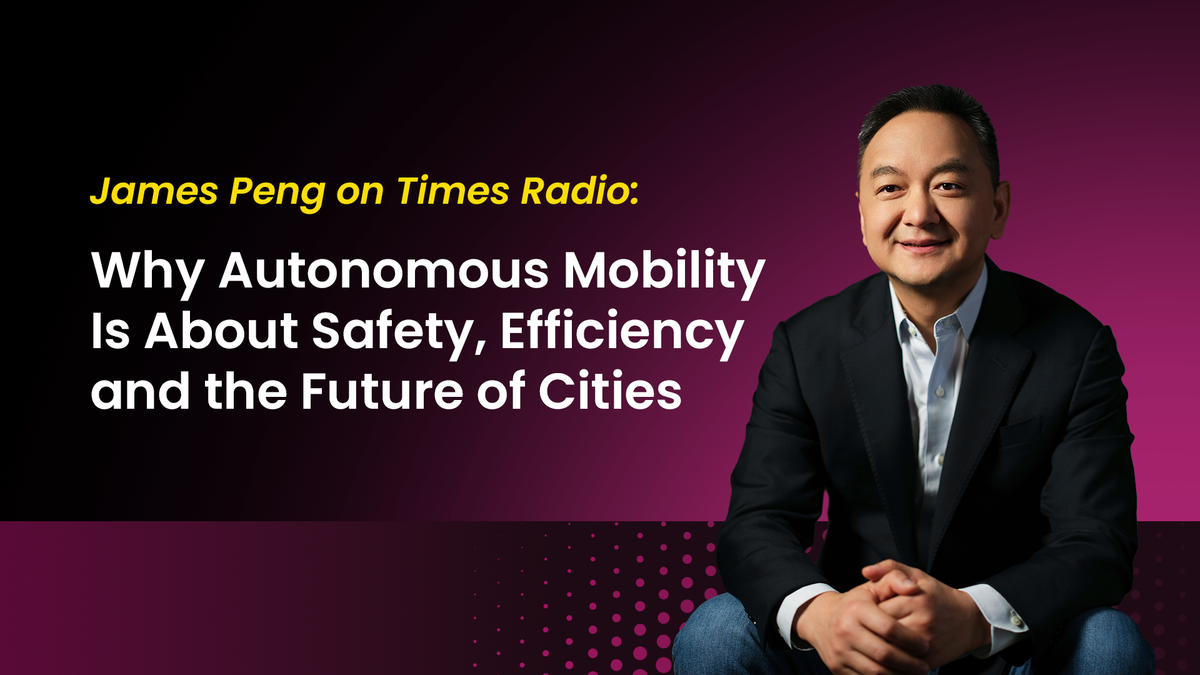
Pony.ai Founder and CEO James Peng recently joined Times Radio for a conversation with broadcaster Fi Glover on how artificial intelligence is reshaping travel and urban mobility. The discussion covered a wide range of topics, from the safety case for autonomous vehicles and the long-term future of driving, to job transformation, regulation, and how driverless cars interpret human behavior on the road.
At the heart of the conversation was a question that continues to shape public debate around autonomous mobility: how can society build trust in a technology designed to operate in complex real-world environments? For James, the answer begins with safety. Human error remains one of the leading causes of road accidents, while autonomous driving systems are designed to maintain 360-degree awareness, remain constantly attentive, and improve over time through real-world operations and data-driven iteration.
The conversation also touched on the broader societal implications of autonomous driving. James noted that, while autonomous mobility has the potential to reduce transportation costs and improve system-wide efficiency, its impact must be managed responsibly. New technologies can change the nature of work, and the transition requires collaboration across industry, government, and society to ensure that the benefits of AI-driven mobility are shared more broadly.
Below is an edited version of the interview for clarity and length.
Q: Where does your passion for self-driving cars come from?
James Peng:
The biggest driver is safety. That was the most important reason behind starting Pony.ai.
A large share of road accidents are caused by human error. People may be distracted, tired, nervous, under the influence, or simply fail to notice other road users. Autonomous driving is designed to address many of these risks. With 360-degree sensor coverage and constant attention to the surrounding environment, autonomous vehicles have the potential to avoid many accidents that are caused by human limitations.
There are other benefits as well, including improved efficiency, cleaner mobility systems, and lower transportation costs over time. But for me, safety has always been the starting point.
Q: Many people still see the safety of autonomous driving as a claim rather than a proven reality. How do we know autonomous vehicles will ultimately be safer?
James Peng:
We already have real operational data showing that autonomous driving can be safe — and in our own operations, significantly safer than human driving.
Of course, the technology is still being deployed within defined areas and operating conditions. It is not yet universal in every environment. And, as with any complex technology, there can be rare cases of unexpected behavior. But what is important is the direction of progress.
Human driving safety, as a whole, tends to remain relatively static, and in some cases may even decline because of distraction, mobile phone usage, and shorter attention spans. Autonomous driving systems, by contrast, continue to improve through data, validation, and iteration. Even if the technology is not yet applicable everywhere, its potential to become much safer and more efficient over time is very clear.
Q: By 2050, how much of transportation do you think will be autonomous?
James Peng:
I believe the majority of transportation will become autonomous by then, because it will be safer, more efficient, and more enjoyable for passengers.
Human driving will probably still exist, but it may increasingly become recreational, or remain more common in rural areas and special-use scenarios. For day-to-day mobility in cities, I believe autonomy will become a regular and important mode of transportation.
Q: What do you say to people who enjoy driving, or who worry that autonomous vehicles could displace jobs?
James Peng:
I would look at this from two perspectives.
From a society-wide perspective, technology has always changed the structure of employment. Many industries that once depended heavily on manual labor have become highly automated, and society has had to adjust. Autonomous driving will be part of that broader technological transition.
At the individual level, it is not simply a one-to-one replacement of jobs. New types of work are also being created, including fleet operations, remote assistance, vehicle maintenance, safety supervision, and other roles across the autonomous mobility ecosystem. In many cases, these roles can offer better working conditions. Instead of spending long hours behind the wheel, people may work in fleet operation centers, support vehicle readiness, or help manage services more efficiently.
At the same time, we should not underestimate the challenge. If transportation costs come down and mobility becomes more efficient, that creates value for society. The important question is how we manage the transition and ensure that the value created also supports new opportunities.
Q: AI could create new wealth, but it may not be distributed evenly. What role should entrepreneurs, governments and society play?
James Peng:
This is a much broader question than any single company can solve on its own.
Autonomous driving, and AI more broadly, will likely create significant value for society. But that value may not be distributed evenly. There is a real risk that AI could widen the gap between those who benefit from the technology and those who do not.
As entrepreneurs, we should do what we can to build useful technologies responsibly and create new opportunities where possible. But this also requires policy, regulation, education, and broader social planning. The future of AI cannot be shaped by companies alone. It requires participation from governments and society as a whole.
Q: Human drivers often use gestures, eye contact and small signals on the road. How can autonomous vehicles understand that kind of behavior?
James Peng:
That is a very important question. AI has advanced to the point where autonomous vehicles can recognize many common hand signals, including standard traffic and police signals.
Eye contact is more difficult, and that is not something we rely on today. But autonomous driving systems can understand intent in other ways. For example, at a four-way stop, another vehicle may begin to move slightly forward, which can indicate that the driver intends to go. Our system can analyze these kinds of behavioral cues, along with the surrounding traffic context, to make safe and appropriate decisions.
Driving is not only about following rules. It is also about understanding the behavior and intent of other road users. That is an important part of building autonomous vehicles that can operate safely in real urban environments.