
Building Trust and Scale in Robotaxi Deployment: A Conversation with Pony.ai CFO Leo Wang
In a recent interview with “the etn show”, Leo Wang, Pony.ai’s co-founder and CFO, discussed the company’s progress in China and its approach to expanding Robotaxi operations internationally. The conversation covered Pony.ai’s nearly decade-long development, the rollout of its seventh-generation Robotaxi and the experience it has built through fully-driverless commercial operations in Beijing, Shanghai, Guangzhou and Shenzhen.
The discussion also focused on Zagreb, where Pony.ai, Verne and Uber launched Europe’s first commercial Robotaxi service earlier this year, and recently Pony.ai and Verne began fully driverless test rides with passengers on public roads, marking a European first. Leo explained how experience accumulated in China’s complex urban environments helped Pony.ai adapt its autonomous driving technology to European roads, while emphasizing the importance of local testing, public acceptance and regulatory readiness.
Leo also outlined Pony.ai’s joint deployment model, under which the company provides autonomous driving technology while working with mobility platforms and local fleet operators on service deployment. He discussed the financial logic behind the model, the fleet density required to deliver a competitive Robotaxi service and Pony.ai’s plan with Uber to deploy more than 2,000 Robotaxis across five European cities.
The following conversation has been edited and condensed for clarity and readability.
ETN: Could you start by giving us some background on Pony.ai?
Leo Wang: Pony.ai has been in the autonomous driving industry for close to 10 years. We were founded in 2016, and China remains our home market.
Last year, we began rolling out our seventh-generation Robotaxi. Our largest markets today are China’s tier-one cities: Beijing, Shanghai, Guangzhou and Shenzhen. As of June 30, 2026, we had approximately 1,900 vehicles in our fleet, the majority of them in China. Hundreds of these vehicles are already providing commercial, fare-charging services in major cities.
Building on our deployment in China, we are also exploring opportunities in international markets.
ETN: Why did Pony.ai choose Croatia for its first Robotaxi deployment in Europe?
Leo Wang: We began working with our partner Verne last year. Earlier this year, we started deploying vehicles on public roads in Zagreb and accumulating local mileage to demonstrate that our technology could operate safely and adapt to European road environments.
As we built greater confidence in the deployment, Uber also joined the collaboration. This created a three-party model involving Pony.ai, Verne and Uber, through which we began providing a commercial Robotaxi service in Zagreb.
The next step was to remove the safety operator from the vehicle. We recently announced fully driverless Robotaxi test rides with passengers on public roads in Zagreb. While Robotaxi testing is taking place in several European cities, most programs still have a safety operator onboard. We are therefore very pleased to be part of this fully driverless milestone in Europe.
ETN: Is there a major difference between deploying Robotaxis in Chinese and European cities?
Leo Wang: When we began deploying vehicles in European cities, we were pleased to find that many of the capabilities developed in China transferred well.
China’s tier-one cities include narrow streets, large numbers of pedestrians, heavy traffic and congestion. Our autonomous driving system had already been extensively tested and matured under these conditions. This gave us a strong foundation when entering European cities. It is similar to an experienced human driver adapting to a new city: some local adjustment is still required, but the core driving experience is already there.
At the same time, safety remains our priority. We continue to conduct local testing with our partners and build an operating record on local roads. Technology may be increasingly ready for deployment across multiple markets, but public acceptance and regulatory readiness still need to be established through local experience.
ETN: How does public acceptance of Robotaxis differ between China and Europe?
Leo Wang: In China, we began with tier-one cities. These cities generally have younger, technology-oriented populations that are more willing to try new services. Supporting infrastructure, including electric-vehicle charging, is also relatively mature.
In China, we have taken a highly integrated approach. We operate the services ourselves and work directly through the permitting process. We wanted to be closely involved in every part of commercialization and understand all the details required to make the business model work.
In international markets, the infrastructure and operating environment may be different. Regulators may also prefer to see a local partner involved in the service. Local partners understand the market, know how to work with regulators and can help determine the appropriate pace of deployment.
They also play an important role in public communication. People need to understand the testing and validation behind the technology. Services may initially be introduced to a smaller group of users, with access expanding as the technology establishes a stronger local record.
ETN: How does Pony.ai’s joint deployment model work?
Leo Wang: We sometimes describe it as a three-party or joint deployment model. Pony.ai provides the autonomous driving technology and acts as the AI driver provider.
Other responsibilities are handled by partners. A local company may manage fleet ownership, maintenance and daily operations, while a mobility platform provides access to passengers.
Local partners already have experience managing public-facing services and working with regulators. They understand what operating records and safety information are needed before a service can expand. Their local knowledge can help us enter a market more efficiently and build public acceptance over time.
ETN: How does that model affect Pony.ai’s financial strategy when entering a new city?
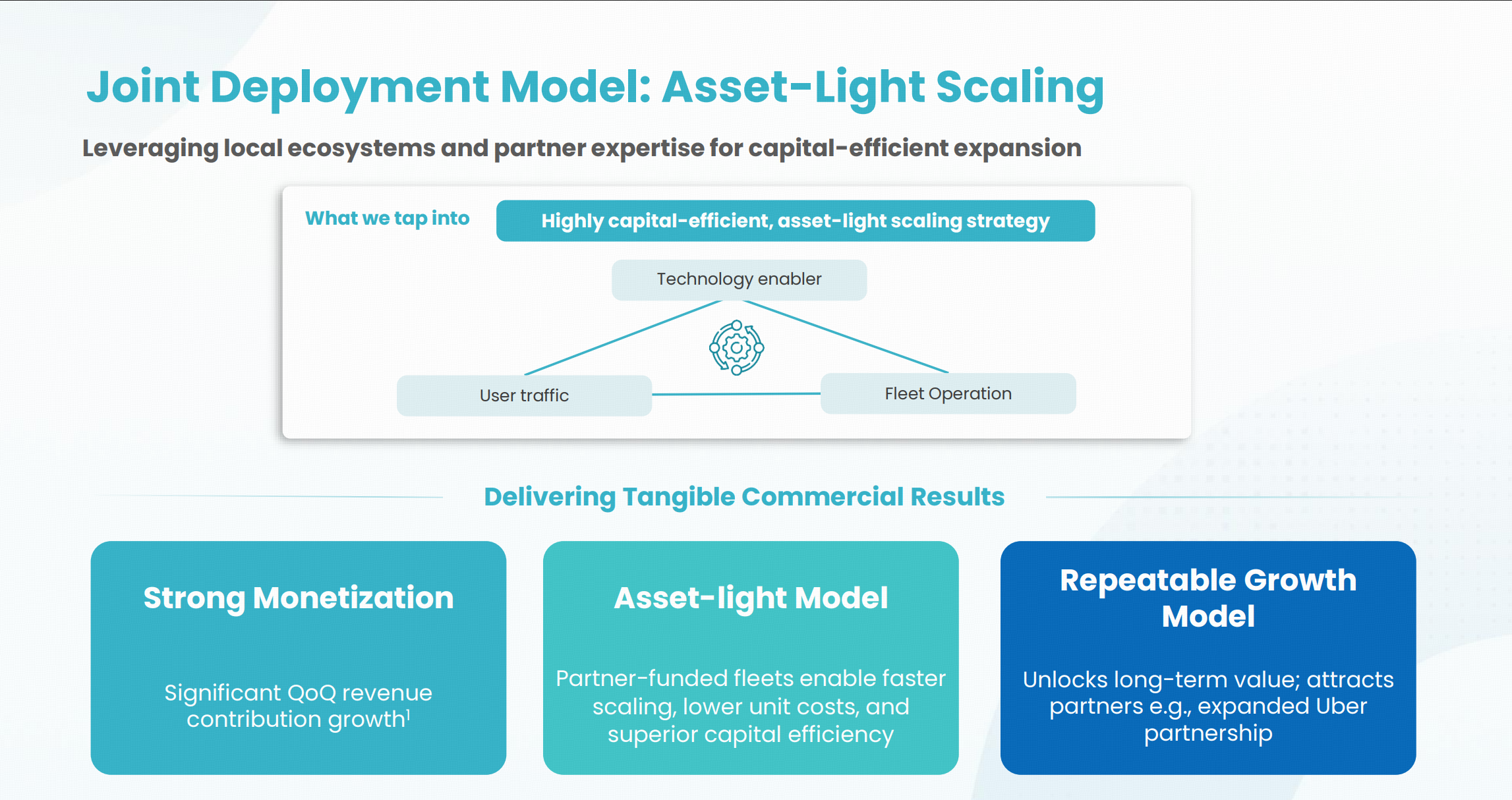
Leo Wang: Under the joint deployment model, the ride-hailing platform or local operating company generally owns the vehicle assets, so the vehicle capex sits with those partners.
For Pony.ai, revenue can come from two main streams. The first is the sale of vehicles to one of the participating parties. The second is a take rate from the gross transaction value generated by the mobility service.
The vehicle owner is effectively hiring an AI driver instead of a human driver. When the Robotaxi provides a ride, Pony.ai can receive a share of the revenue from that service. This creates recurring revenue throughout the vehicle’s operating life.
Zagreb is our first test of this model. As the fleet reaches a larger scale, the financial structure should become more meaningful and provide a model that we can apply in other markets.
ETN: What level of fleet scale is needed for a Robotaxi service to work effectively in a city?
Leo Wang: We look at this on a city-by-city basis. A mobility service needs sufficient fleet density so that passengers can request a vehicle and receive it within a reasonable amount of time.
If passengers have to wait 15 minutes for a vehicle, they may not consider it a good service. Based on our experience, a city would need at least around 100 vehicles to begin creating meaningful service density. Ideally, several hundred vehicles would provide a stronger operating base.
Scale also helps improve operational efficiency. It allows us to optimize vehicle availability and determine the right ratio of backend personnel needed to support a larger fleet.
ETN: What can you share about Pony.ai’s next steps in Europe?
Leo Wang: We have announced with Uber that the two companies plan to deploy more than 2,000 Robotaxis across five European cities.
Zagreb is one of those cities. We look forward to exploring additional European markets together, with further details to be announced in phases.